

Castilla-La Mancha is Spain’s wine engine: vast, sunbaked, high-elevation, and responsible for a huge share of the country’s production. Stretching across the Meseta Central (Central Plateau), this region is home to everything from humble everyday wines to some of Spain’s most ambitious modern bodegas. Explore Castilla-La Mancha and discover bold reds, distinctive native grapes, and one of the most dynamic wine landscapes in Spain.
Where Spain Overdelivers! Castilla-La Mancha offers everything from easy-drinking wines under $10 from Castilla-La Mancha IGP to $100 bold red blends under the Vino de Pago designation.
Wines from Meseta Central
For decades, the Meseta Central was known for bulk wine production — simple red and white wines sold across Spain in large-format containers. Quality accelerated in the 1990s as producers invested in lower yields, temperature-controlled fermentation, modern irrigation, and international grape varieties.
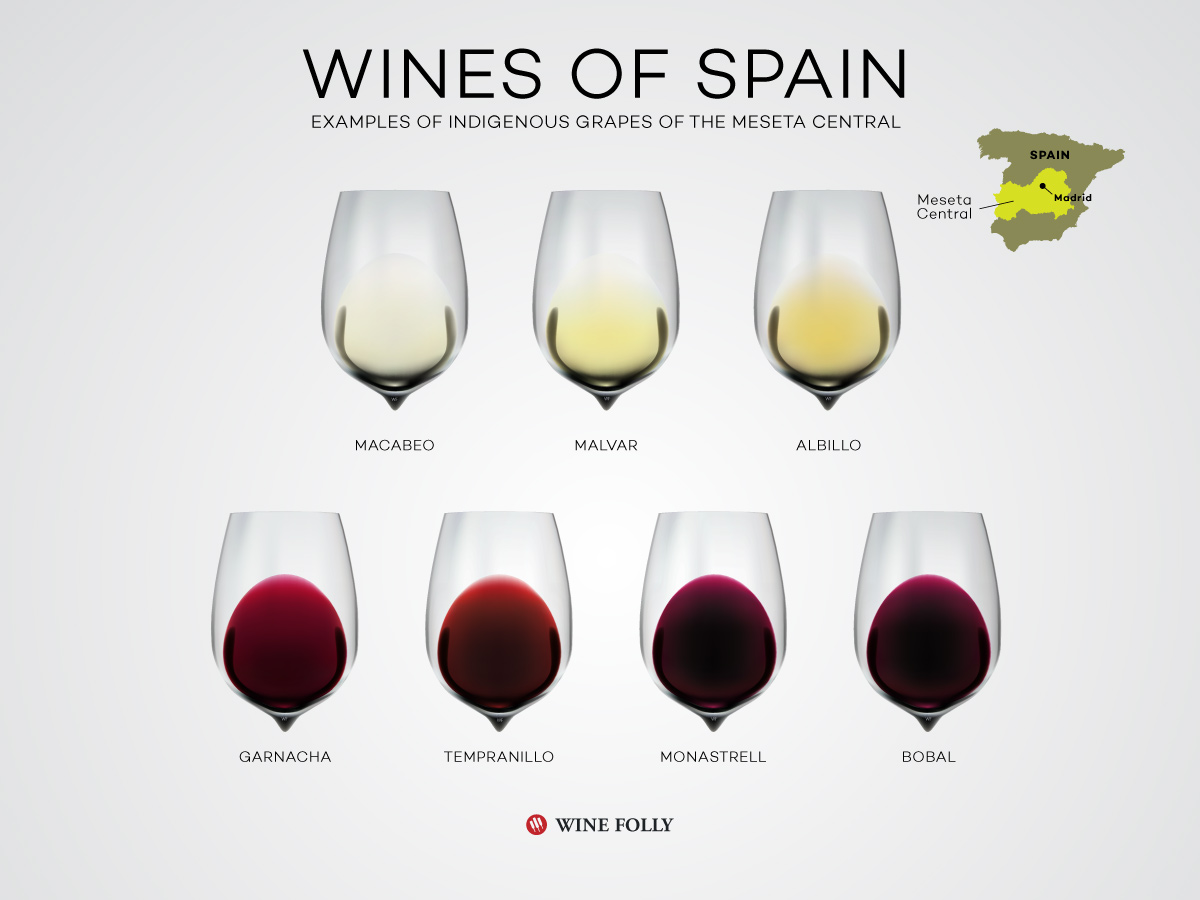
The greatest wines of the region are bold, lush red wines with a characteristic note of charred herbs and toast. The best whites balance ripe orchard fruit with texture, saline minerality, and restrained oak.
The Wines of Central Spain
Nearly all of the top-quality wines in the area incorporate international varieties, such as Syrah, Cabernet, and Petit Verdot, along with local grapes such as Tempranillo, Garnacha, and Bobal.
- Tempranillo: The traditional name of Tempranillo in Castilla-La Mancha is Cencibel. Here, the grape tends to produce darker-colored, fuller-bodied wines than those typically found up north in Rioja, thanks to the region’s warm climate and intense sunshine.
- Bobal: A very bold, red wine grape often compared to Petite Sirah, Bobal has blackberry and menthol flavors. Vanilla notes come from oak aging.
- Garnacha: Richer in style, moderately high in alcohol and tasting of candied raspberries and leather.
- Cabernet & Merlot: Red fruit flavors dominate the Cabernet and Merlot of Spain, but producers often blend these grapes with others for a deeper, darker, and much more intense flavor.
- Monastrell: Opaque with a bright violet rim, Monastrell (a.k.a. Mourvèdre) tastes of blackberries, anise, grilled bread with the occasional meaty note.
- Syrah: Syrah thrives in the dry continental climate, producing wines with dark fruit, black pepper, and savory earthiness.
- Petit Verdot: Opaque in color like Monastrell but with flavors of blackberry, violet, graphite, and dried herbs.
- Albillo: A white wine that’s often oaked with medium acidity and slightly nutty, oxidative flavors of apricot, aniseed, and dried flowers.
- Malvar: A white grape tasting of peaches and tropical fruit, orange blossom, and citrus that’s rarely oaked. Malvar is a significant grape in Vinos de Madrid.
- Macabeo: (a.k.a. Viura) A white grape that is also a major grape in Cava. Macabeo is sometimes blended with Chardonnay to create a light unoaked white wine.

A lil’ History
One of the key figures in modern Castilla-La Mancha wine was Carlos Falcó Fernandez de Córdova of Dominio de Valdepusa in the Méntrida DO (“DO” stands for Denominación de Origen). Carlos Falcó studied winemaking at UC Davis in 1964 and was among the early advocates for modern vineyard practices, including drip irrigation and international grape varieties. Before water-saving drip systems were introduced, it was illegal to water vineyards in the Meseta Central.
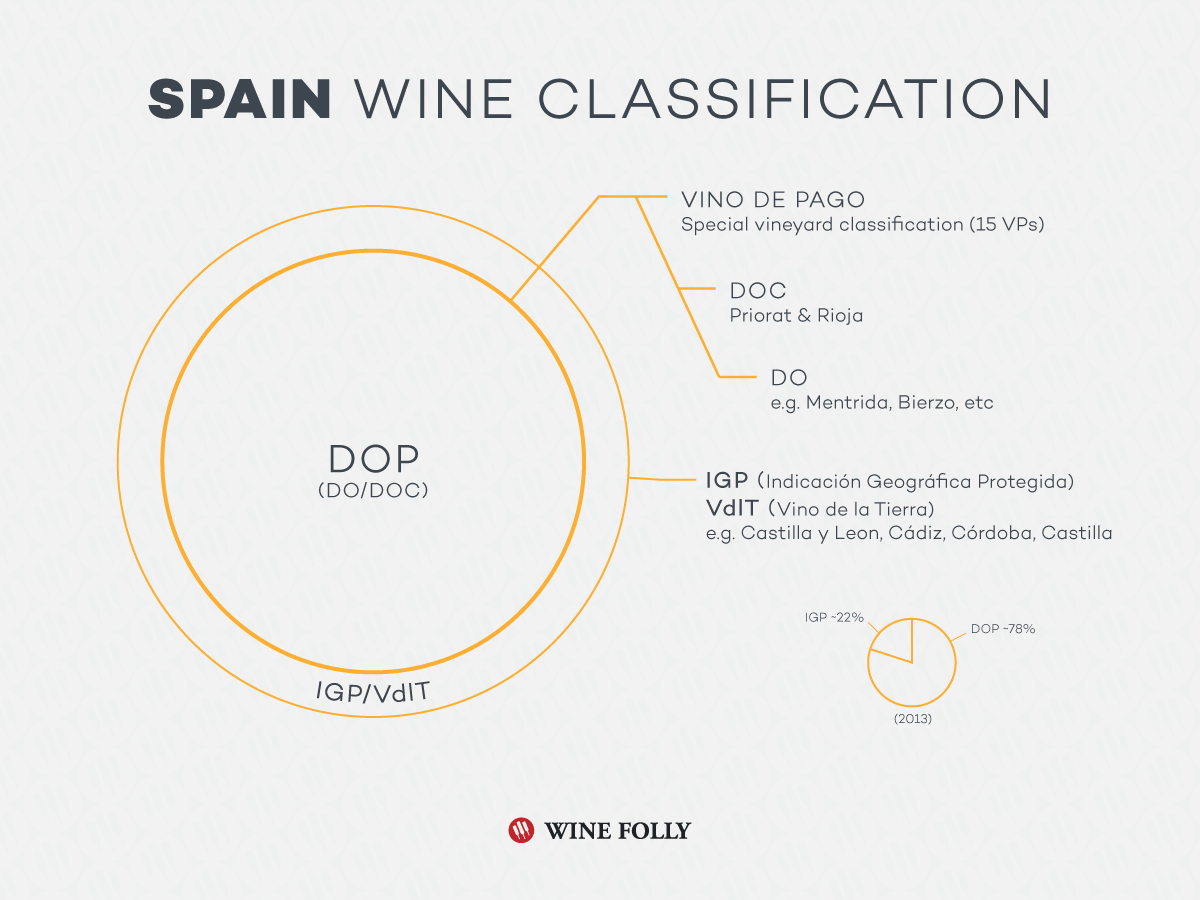
Vino de Pago: The Top Spanish Classification?
Falcó’s work led to the creation of Vino de Pago, which represents Spain’s highest single-estate wine classification. His Dominio de Valdepusa vineyard was the first estate recognized under the Vino de Pago classification. As of 2026, there are 27 Vinos de Pago in Spain.
Carlos Falcó also organized a group of 25 top-quality producers in the Meseta called Grandes Pagos de España. Some of these are not official Vino de Pago, but they are all worth seeking out.
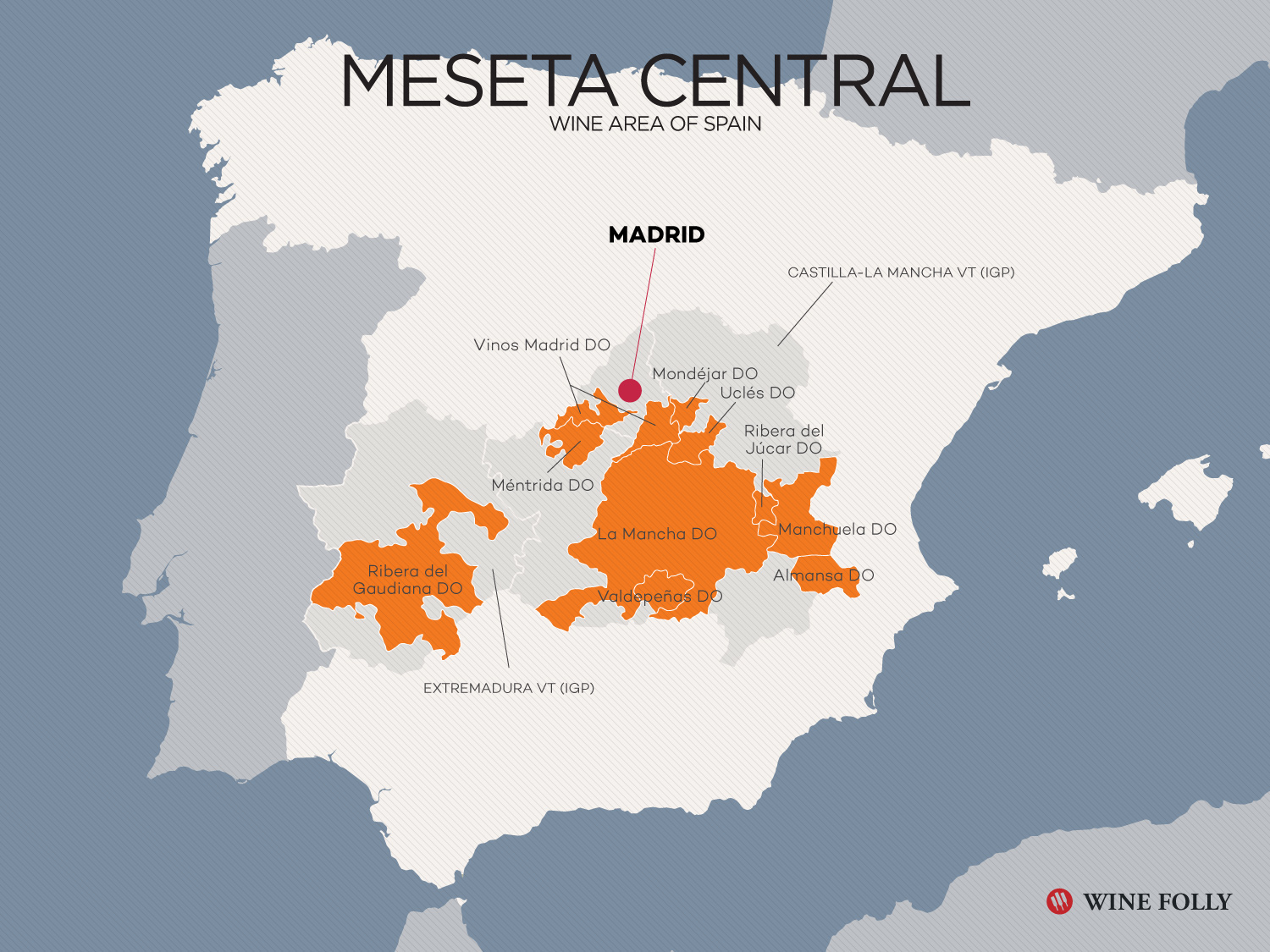
Meseta Central Spain Wine Region Map
The region contains Madrid and the surrounding areas in the high plateau of Spain. The climate is intensely continental: scorching summers, cold winters, and very little rainfall.
Castilla-La Mancha and Extremadura IGP/VT
These are the overarching regions that contain most of the Meseta. IGP (Indicación Geográfica Protegida) wines are the basic wines in the area. There are fewer regulations for IGP wines, so you’ll also find unique blends or grape varieties (like Viognier) that typically wouldn’t earn a DO (Denominación de Origen) status. Many deliver exceptional value despite modest pricing.
La Mancha
A vast region with extensive plantings of white grapes ranging from Airén and Macabeo to Chardonnay and Sauvignon Blanc, which pair naturally with the region’s famous Manchego cheese.
Méntrida
One of central Spain’s most quality-focused regions with the first Vino de Pago wines made by Bodega Marqués de Griñón. It produces mostly Garnacha along with ‘Bordeaux blends’ and a lush style of white Albillo.
Ribera del Júcar
Wines here are made with blends of Cabernet, Syrah, Petit Verdot, and Tempranillo.
Uclés
A value-driven region dominated by larger producers making mostly fruit-forward Tempranillo and Verdejo. Even though large producers dominate, the region shows potential in its higher-elevation vineyards.
Manchuela
A value-driven but smaller producer-focused region with several intriguing wineries championing the indigenous Bobal for both red and rosado wines. Garnacha is also prevalent here, along with international varieties. Organic farming has expanded rapidly here.
Mondéjar
A value-driven region dominated by larger producers making mostly fruity-styled Tempranillo and white Malvar.
Almansa
Home to a 15th-century castle, Almansa excels at powerful, structured Monastrell and deeply colored Alicante Bouschet blends, which is one of the few grapes with both red skins and red flesh.
Valdepeñas
A value-driven region producing wines of Tempranillo with an aging system very similar to Rioja.
Vinos de Madrid
Urban expansion continues to pressure historic vineyard land near Madrid. In the southern zones, there is a focus on two local white grapes: Malvar and Albillo. The area of Vinos de Madrid that’s farthest from the city has many ancient Garnacha vineyards.
Ribera del Guadiana
Bordering Portugal, Ribera del Guadiana works with an unusually broad mix of Spanish, Portuguese, and international grape varieties. There is a focus on Tempranillo, Cabernet Sauvignon, Syrah, and Malvar.