

Tired of hearing about Tuscany? Meet Alto Adige, a small Italian wine region with a surprisingly big lineup. Here, Pinot Grigio gets a serious upgrade: fresh, mineral, and capable of being far more interesting than its supermarket reputation suggests.
Alto Adige Pinot Grigio can be bright, mineral, and seriously refreshing, with the kind of acidity that makes your mouth perk up. And don’t stop at white wine. Alto Adige is home to two distinctive reds: fruity, easygoing Schiava and powerful, savory Lagrein.
Discover delicious Italian wines and beautiful regions in the Alto Adige Region Guide.

Alto Adige Wine Region
Way up in northern Italy, Alto Adige lies in a ‘Y’ shaped glacial valley right below Austria. Long before planes, trains, or highways, these Alpine valleys served as important routes between northern Europe and Italy. Its position at the crossroads of the Alps made Alto Adige strategically important for centuries, and the region changed political hands repeatedly.
Alto Adige became part of Italy after World War I. Today, Italian and German are official languages throughout the province, while Ladin has official status in the Ladin-speaking areas.
Vineyards climb steep slopes and valley floors, from warm, low-elevation sites around Bolzano to cooler Alpine vineyards higher up. You’ll also see German names throughout the region, including Schloss, meaning ‘castle.’
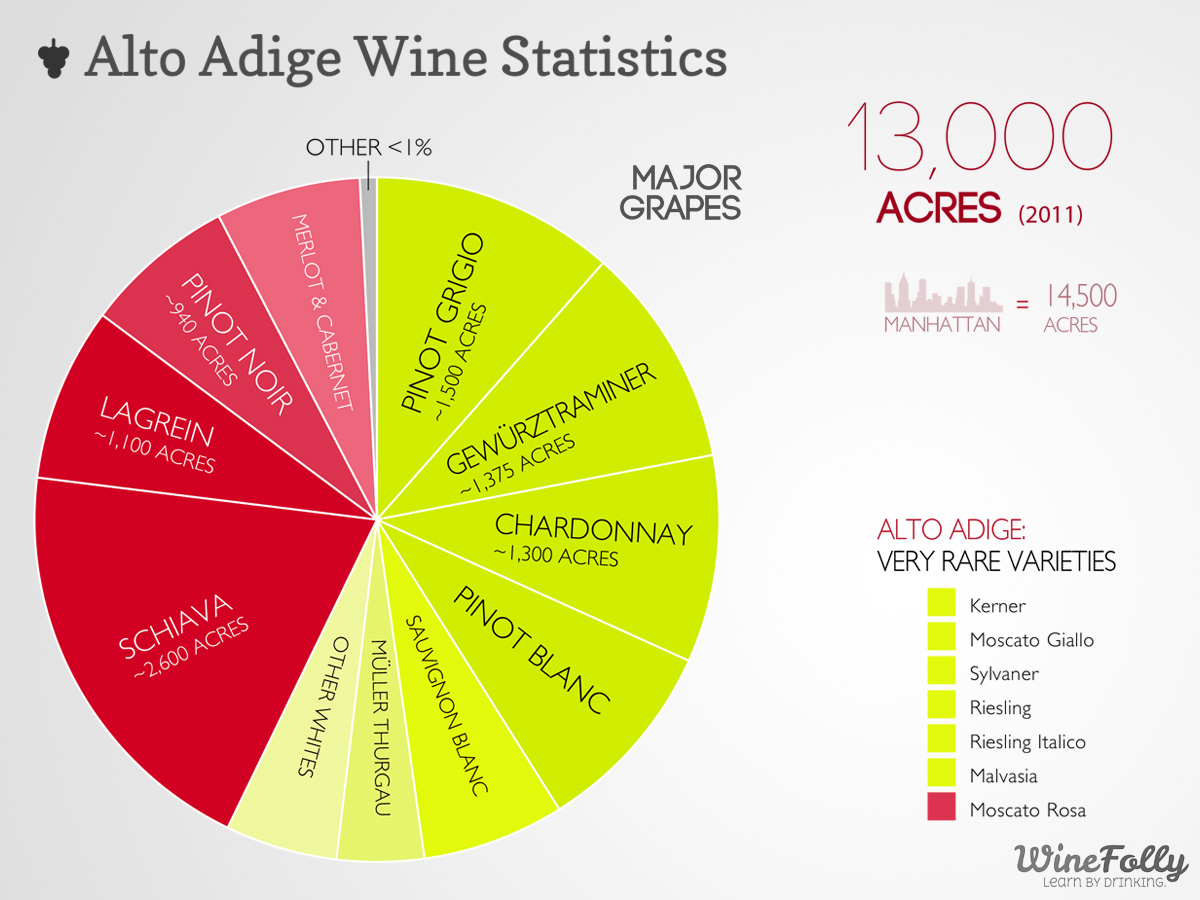
Alto Adige is quite tiny at around 14,000 acres, but the region varies enough to have seven distinct growing subregions. The city of Bolzano is smack-dab in the center of Alto Adige and has some of the most amazing scenery.

Buying Alto Adige Wine?
Don’t be surprised if the wine on the shelf says Trentino-Alto Adige. Alto Adige and Trentino are neighboring wine areas within the larger Italian region of Trentino-Alto Adige/Südtirol.
Trentino lies directly south of Alto Adige and is particularly known for Trentodoc, its traditional-method sparkling wine.
Because German is one of Alto Adige’s official languages, German grape names are common on wine labels. For example, Weißburgunder is the German name for Pinot Blanc.
What Does Alto Adige Do Best?
Pinot Grigio and Pinot Bianco together account for about 22% of Alto Adige’s vineyard area, making these white grapes a major part of the region’s identity. Depending on where they’re grown, Alto Adige’s Pinot Grigio and Pinot Blanc can show citrus, stone fruit, floral notes, minerality, and a subtle nutty character.
Alto Adige’s Pinot Grigio can scratch the same itch as crisp Grüner Veltliner or Riesling: fresh acidity, mineral character, and plenty of food-friendly versatility. In contrast, Pinot Bianco (Weißburgunder) can sometimes offer a richer, more textured alternative.
Other White Wines
Gewürztraminer is intensely aromatic, with lychee, rose, spice and ginger notes. It can range from dry to off-dry. It has deep roots in Alto Adige, and its name comes from the village of Tramin.
Müller Thurgau is Gewürztraminer’s lighter, more floral friend with citrus blossom aromas. Müller Thurgau also grows in Bassa Atesina but in the highest elevation vineyards — up to 3,300 feet.

Red Wines from Alto Adige
Schiava
If you love light, fruity reds like Beaujolais or Pinot Noir, add Schiava to your repertoire. Think strawberry, raspberry, floral notes, and a little candy-shop sweetness on the nose, followed by bright acidity. If Beaujolais is your thing, Schiava belongs on your list. It’s light, juicy, low in tannin, and dangerously easy to drink.
New to Old World reds? Schiava is an easy place to start. It’s light-bodied, low in tannin, and packed with fresh red-fruit and floral flavors.
Lagrein
Lagrein has been around for centuries, with written references dating back to the Middle Ages. With roughly 1,350 acres in Alto Adige, Lagrein is relatively hard to find. Dark berries, spice, firm tannins, and fresh acidity give Lagrein the structure to age. Don’t expect a rush of fruit, if you like Syrah or Barbera, Lagrein is worth a detour.